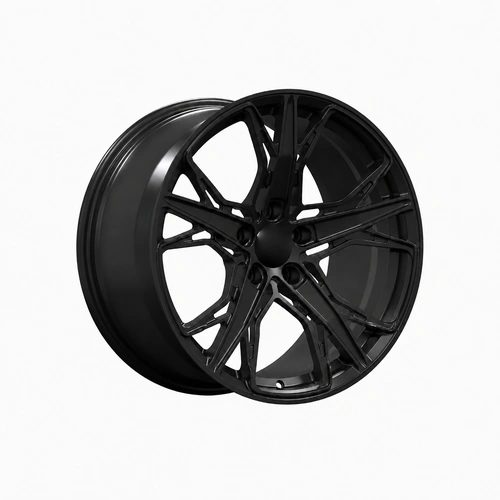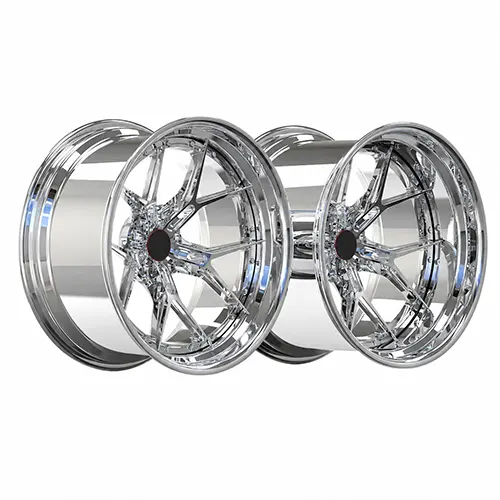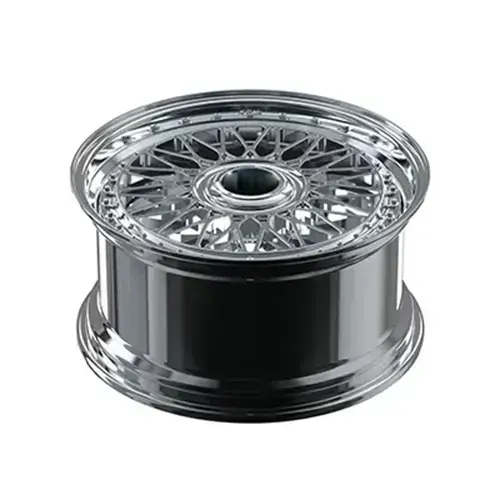
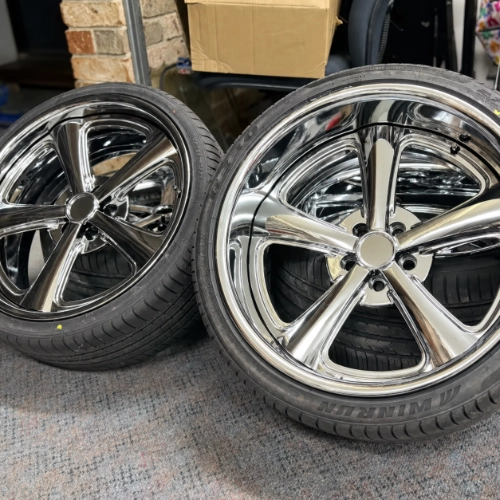
1985 Ford XF Falcon — Full Chrome Classic 5-Spoke 2-Piece Forged (20" Staggered, Deep Lip)
- Model: RC1212-1XT (1980 F / 2012 R)
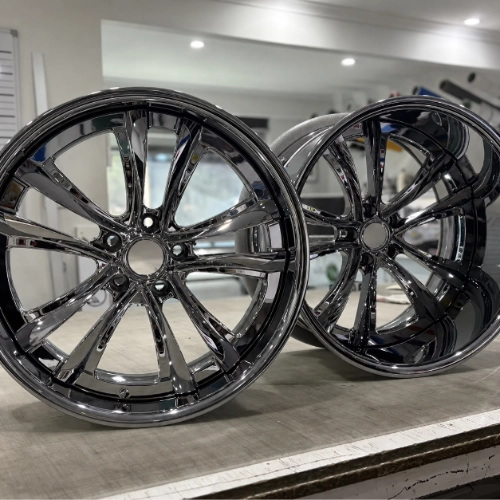
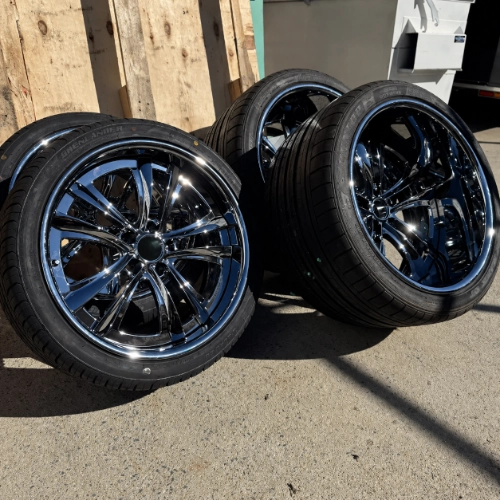
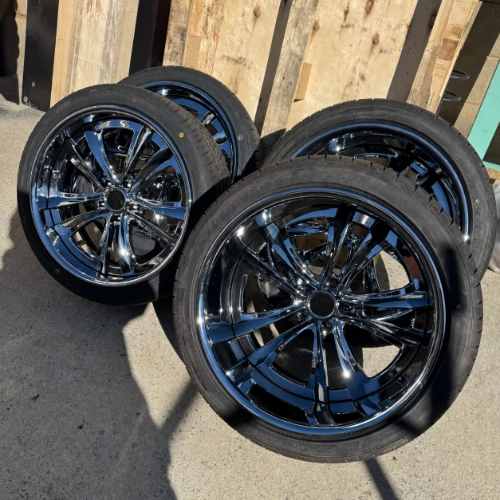
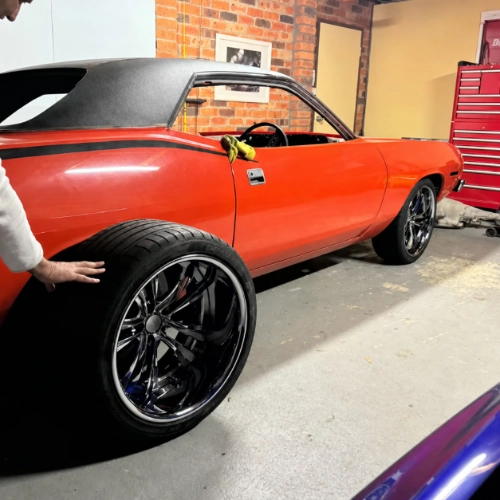
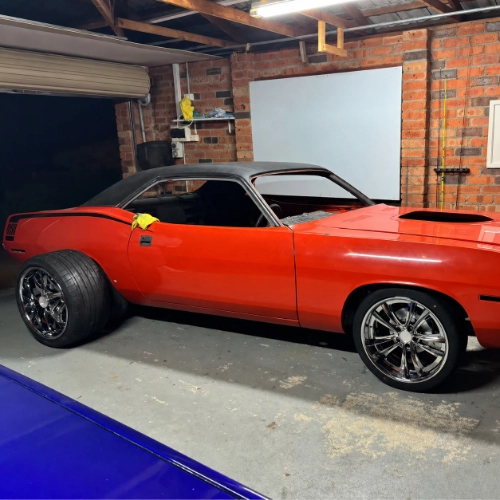
Rear geometry is the defining feature before finish enters the conversation. A 20×12 section, ET-57.5 and a measured 174.5 mm outer lip create genuine physical depth, while the 19×8 ET0 front remains intentionally restrained. Forged two-piece construction allows front and rear to carry very different proportions without forcing exaggerated face depth at both axles. Full electroplated chrome is applied only after that geometry is complete, revealing the barrel rather than manufacturing the illusion of one.



Specifications
| Item | Specification |
|---|---|
| Model No. | RC1212-1XT (1980 F / 2012 R) |
| Size (Front) | 19×8.0 inch |
| Size (Rear) | 20×12 inch |
| PCD | 5×114.3 mm |
| Offset (Front) | ET0 |
| Offset (Rear) | ET‑57.5 (deep negative offset) |
| Center Bore | 71.6 mm (customer-confirmed hub) |
| Lip Depth (Front) | 56 mm |
| Lip Depth (Rear) | 174.5 mm |
| Weight (Front) | 12.8 kg |
| Weight (Rear) | 15 kg |
| Load Rating | 750 kg per wheel |
| Finish | Bright Chrome electroplating (copper base → nickel → chrome, full-wheel plated) |
| Construction | Forged Two‑Piece (forged center + spun barrel, bolt‑joined) |
| Lead Time | 45 days (two‑piece assembly + full electroplating pipeline) |
-
Descriptions

Engineering Notes
Rear barrel geometry carries the engineering story.
Forged 6061-T6 forms the center, while a separately manufactured barrel provides the physical section required by the 20×12 ET-57.5 rear wheel.
Outer-lip depth reaches 174.5 mm.
Functional hardware joins the two sections, followed by O-ring sealing and airtight pressure testing before the wheel moves into its finishing stages.
Front geometry takes a very different direction at 19×8 ET0, creating deliberate asymmetry between the axles.
174.5 mm Replaces Vague “Deep Dish” Language
Physical lip depth gives customers something concrete to evaluate.
174.5 mm directly explains why the rear wheel looks dramatically different from the front when viewed from an angle.
No exaggerated marketing term is necessary. Geometry already provides the selling point.
Full Chrome Amplifies Existing Depth
Chrome does not generate the rear profile.
Machining and two-piece architecture establish that first.
Pre-plating polishing is followed by copper, nickel and chromium stages, allowing mirror reflection to travel deep into the finished barrel and make the physical section more apparent.
Post-Plating Inspection Protects the Geometry
Electroplating happens after critical machining has been completed.
Final dimensional re-verification therefore confirms that the completed plated wheel still corresponds with the intended dimensions and runout requirements.
That step carries particular relevance when one of the product’s defining attributes is a precisely stated rear-lip depth.
From Design to Delivery
Quality Verified
- CMM dimensional inspection (PCD / CB / runout)
- Dynamic balancing on every wheel
- 2-piece hardware torqued to spec & pressure-tested for seal
- Forged 6061-T6, hub-centric machining verified
- Multi-layer chrome plating adhesion & mirror QC before packing
Result
Front wheel proportions remain comparatively restrained. Rear geometry expands into a 174.5 mm outer lip that immediately changes the visual balance of the car.
Chrome intensifies that contrast, but the finish is not the reason the rear looks deep.
Physical wheel architecture is doing the work.
That single measurable characteristic gives this XF Falcon build a far stronger engineering memory point than generic “deep-dish forged wheel” language.

Restoring a 1970s
–80s Australian FoMoCo Falcon, an American Mopar E-Body, an F-Body Camaro, or any classic muscle / sedan platform that's already been mini-tubbed for deep-dish stance?XINGTU forges to your exact submitted fitment—including staggered 19–22" diameters, deep-negative offsets, spun deep-lip barrels, and full chrome / painted / brushed finishes.
-
Build & Fitment
19×8 ET0 and 20×12 ET-57.5 Are Different Wheel Packages
Diameter, width and offset all change from front to rear.
No individual figure explains the completed stagger on its own.
ET-57.5 Needs to Be Read Together With 12-Inch Width
Offset determines mounting-face position relative to centerline.
Width determines how much wheel section surrounds that reference.
Combined geometry creates the extreme rear position.
174.5 mm Requires Matching Vehicle Space
Widened arches, mini-tub work and suspension preparation are already part of the associated restomod package.
Comparable rear space would be required before transferring the same dimensions to another car.
5×114.3 Is Retained
Ford 5×114.3 mounting architecture remains in use.
CB71.6 corresponds with the confirmed hub dimensions supplied for the finished build.
Lip Depth Is an Outcome of Fitment
Changing width, offset or center position changes available outer-barrel depth.
Lip dimension should therefore follow the complete package rather than be selected independently.
Structural Rating Remains 750 kg Per Wheel
Completed wheel capacity is rated to 750 kg after assembly and finishing.
-
FAQs
1. Is 174.5 mm the actual rear lip depth?
Yes. It is a stated physical wheel dimension.
2. Which dimensions create the deep rear profile?
20×12 sizing, ET-57.5 and two-piece architecture work together.
3. What front specification is used?
19×8 ET0.
4. Why use two-piece construction?
Separate center and barrel components allow the rear section to develop far more physical depth than the front.
5. Can the same rear wheel be fitted to an unmodified XF Falcon?
No such assumption should be made. Body and suspension preparation formed part of this vehicle package.
6. How is the two-piece joint sealed?
Fasteners are torqued, an O-ring seals the interface and the assembly is pressure-tested.
7. Is the chrome finish painted?
No. Full electroplating is used.
8. Why is dimensional inspection repeated after chrome plating?
Final verification checks the completed wheel after the finishing process.
9. What load rating is specified?
750 kg per wheel.
10. Can the center design be retained with a shallower barrel?
Yes. Width, offset and barrel geometry can be developed around another confirmed chassis.
Related Products