19" Monoblock Forged Wheels for 2010 BMW 5 Series F10 | Polished Gold Face + Candy Red Barrel
- Model: CD-72010
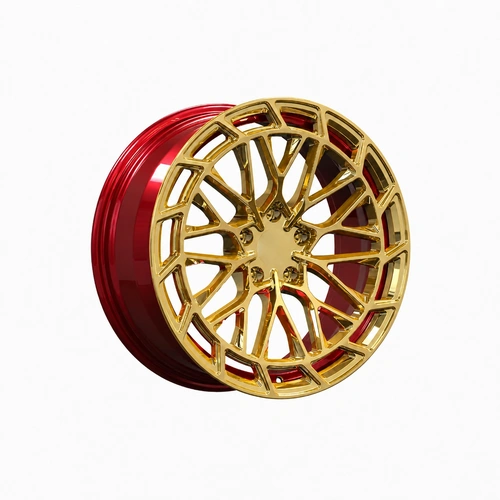
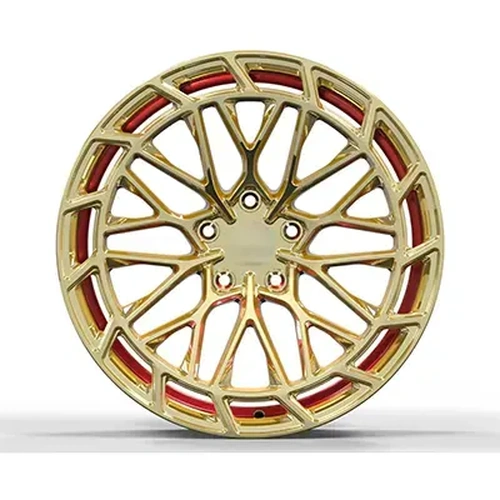
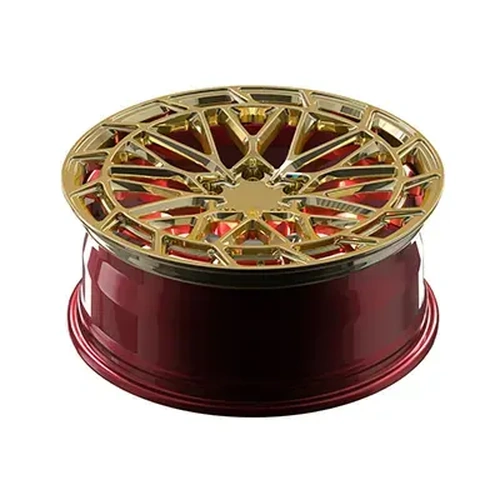
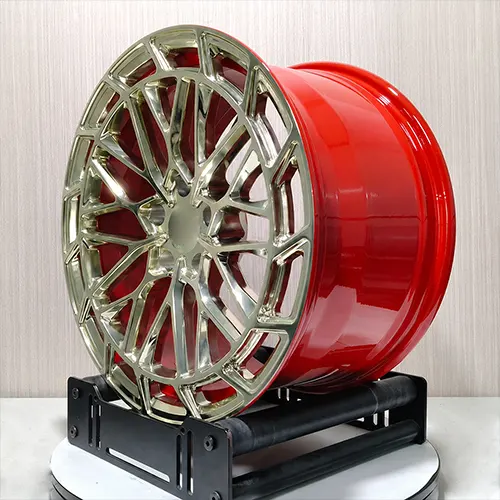
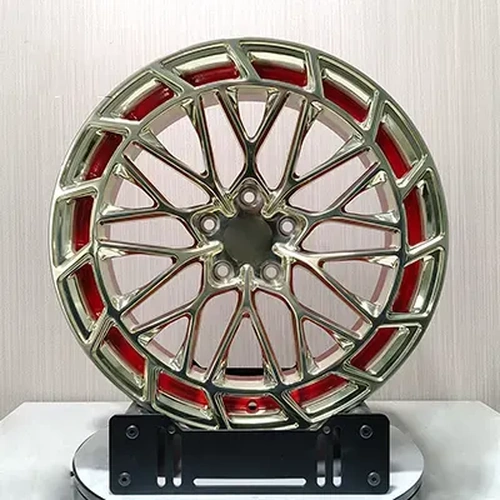
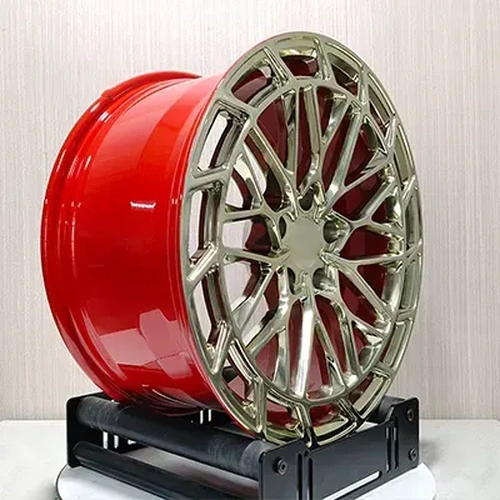
An intricate gold mesh dominates the face, while Candy Red appears deeper inside the wheel as the viewing angle changes. What makes the construction more interesting is that both surfaces belong to the same forged monoblock rather than separate center and barrel assemblies. The 19-inch setup combines a highly detailed CNC-machined face with 11.3 kg and 11.8 kg finished weights, an 850 kg load rating, and a finish treatment that gives the wheel a distinctly custom character without hiding the engineering underneath.


Specifications
| Item | Specification |
| Model No. | CD-72010 |
| Front Wheel Size | 19x8.0 |
| Rear Wheel Size | 19x9.0 |
| Bolt Pattern (PCD) | 5x120 |
| Front Offset (ET) | 30 |
| Rear Offset (ET) | 44 |
| Center Bore (CB) | 72.6 mm |
| Lug Spec | 15×32×60 (taper) |
| Front Weight | 11.3 kg |
| Rear Weight | 11.8 kg |
| Load Rating | 850 kg |
| Construction | Monoblock Forged |
| Finish | Polished Gold Face + Candy Red Translucent Barrel |
-
Descriptions

Engineering Notes
Complexity is concentrated in the face rather than in the wheel assembly.
The interwoven mesh is CNC-machined from a single forged blank, so the narrow spokes remain part of one continuous monoblock structure. With so many intersecting lines across the 19-inch face, spoke position and concentricity become especially visible; small inconsistencies would interrupt the entire pattern rather than disappear within a simpler five-spoke design.
The wheel uses 19×8 ET30 at the front and 19×9 ET44 at the rear, with finished weights of 11.3 kg and 11.8 kg. Both versions retain the published 850 kg load rating. The mounting interface is specified as 5×120 PCD, CB72.6 and a 15×32×60° taper seat.
Those numbers support the product rather than define its personality. The real engineering value lies in producing a detailed mesh face, controlled fitment and measurable load capacity within one forged body.
One Forged Body, Two Completely Different Visual Zones
Polished Gold draws light across the fine mesh and makes the individual spoke paths easy to read. Deeper inside the wheel, the barrel changes to Candy Red, creating a strong shift in tone without adding another physical wheel section.
That distinction is important because the specification remains Monoblock Forged.
Candy Red is described on the existing page as a translucent layer over polished aluminum. Instead of behaving like an opaque red paint, it allows the metallic base beneath to contribute to the depth of the finish. The gold face therefore appears bright and defined from the front, while the red becomes increasingly prominent when more of the barrel is visible.
The effect changes naturally with perspective, which gives the wheel more visual interest than a conventional two-tone face where both colors sit on the same plane.
The Mesh Carries the Identity
Gold and red attract attention quickly, but the wheel would lose most of its character without the underlying spoke architecture.
The fine interwoven pattern creates a dense, almost woven appearance while retaining open sections between the spokes. Polished Gold emphasizes those lines rather than flattening them into a single bright surface.
Because no exposed assembly bolts or separate outer rim interrupt the face, the eye stays on the mesh itself. That makes the design feel intricate without reading like a traditional multi-piece show wheel.
From Design to Delivery
Quality Verified
The dense spoke pattern and high-contrast surface treatment make consistency easy to see. Dimensional inspection therefore matters across the complete forged face, while final checks cover balance, the published structural rating, taper-seat fit and the two-tone finish.
- Quality Verified 100% CMM dimensional inspection
- Dynamic balancing
- Structural load testing (850kg rated)
- Taper-seat fit check
- Two-tone candy finish QC
Result
The finished wheel has more depth than its monoblock construction initially suggests.
Viewed directly, the Polished Gold mesh is the dominant feature. From an angle, the Candy Red barrel begins to frame the gold face from behind, revealing a second visual layer without changing the underlying one-piece architecture.
The rear wheel gains one inch of width, but the fitment remains secondary to the face design rather than becoming an exaggerated deep-lip statement. That restraint works in the wheel’s favor: the intricate mesh and unusual surface treatment already provide enough visual distinction.
With finished weights of 11.3 kg and 11.8 kg and an 850 kg rating, the wheel also carries concrete engineering information behind what is otherwise a highly expressive finish.

Want a bold two-tone or candy finish for your luxury sedan?
Get a monoblock forged setup tuned to your exact fitment
-
Build & Fitment
Fitment Keeps the Face in Proportion
Both axles remain at 19 inches, allowing the intricate mesh to retain the same overall scale around the car.
The front uses a narrower 8-inch section, while the rear moves to 9 inches. The difference adds rear width without changing diameter or forcing the wheel into a dramatically different rear face.
That matters on this design because excessive dish or an oversized rear profile would compete with an already detailed mesh center.
ET30 and ET44 Work With Their Respective Widths
Offset changes alongside wheel width.
ET30 belongs to the 19×8 front specification, while ET44 is paired with the wider 19×9 rear. Those values should be read together with wheel width rather than treated as isolated stance numbers.
The combination gives each axle its own positioning while allowing the same mesh architecture to remain visually consistent across the set.
The Mounting Interface Is More Than 5×120
The recorded specification combines 5×120 PCD, a 72.6 mm center bore and a 15×32×60° taper seat.
Keeping those dimensions together gives a more complete picture of the wheel-to-hub interface than simply describing the wheel as 5×120 compatible.
Finished Weight Remains Measurable
The front wheel is listed at 11.3 kg and the rear at 11.8 kg.
That half-kilogram difference accompanies the wider rear wheel and should simply remain as published data rather than being turned into an unsupported performance claim.
Both retain the same 850 kg load rating, giving customers a useful reference for the completed forged wheel rather than an abstract claim about strength.
Finish and Fitment Can Be Treated Separately
The gold-and-red treatment defines this particular version, but it does not have to dictate the underlying wheel dimensions.
Another F10 can retain the interwoven mesh while using a different finish or fitment specification. If the vehicle setup changes, XINGTU can review the dimensions before machining so the final wheel remains appropriate to the intended application.
-
FAQs
1. Is this a two-piece forged wheel?
No. It is a forged monoblock. The gold mesh face and Candy Red barrel are different finish zones on the same one-piece wheel.
2. How is the mesh face produced?
The existing Engineering Notes state that the intricate interwoven face is CNC-machined from a single forged blank.
3. What makes the Candy Red barrel different from a conventional red finish?
The page describes Candy Red as a translucent layer over polished aluminum, allowing the metallic surface beneath to influence the final appearance.
4. What sizes are used?
The front wheel measures 19×8, while the rear measures 19×9.
5. What offsets are specified?
ET30 is used at the front and ET44 at the rear.
6. How much do the wheels weigh?
The front wheel is listed at 11.3 kg and the rear at 11.8 kg.
7. What load rating is published?
Each wheel is rated to 850 kg.
8. What bolt pattern and center bore are used?
The specification records 5×120 PCD and a 72.6 mm center bore.
9. What lug seat is specified?
The wheel uses a 15×32×60° taper seat.
10. Why use Polished Gold on such a detailed mesh?
The reflective surface emphasizes the fine spoke paths and helps the interwoven geometry remain visible across the dense face.
11. Why does the Candy Red become more noticeable from an angle?
The red treatment is located on the barrel area behind the face, so more of it enters view as the wheel is seen from the side or three-quarter angle.
12. Can another finish be used with the same mesh design?
Yes. The mesh architecture and finish treatment are separate decisions, while final dimensions should still be checked for the intended vehicle setup.
More Forged Wheel Cases