18" 2-Piece Forged Mesh Wheels for 2010 Lexus IS250 AWD | Silver Mesh + Polished Lip + Gold Rivets
- Model: RC065-41XT
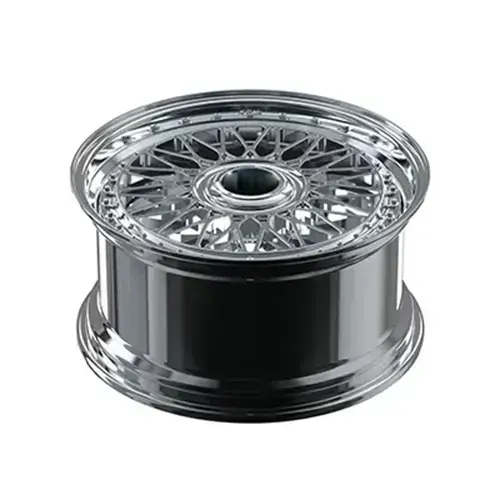
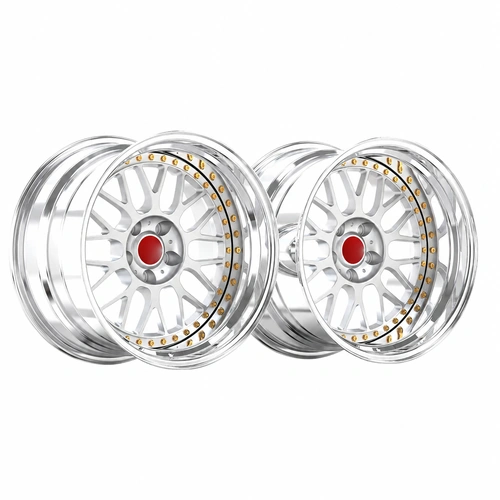
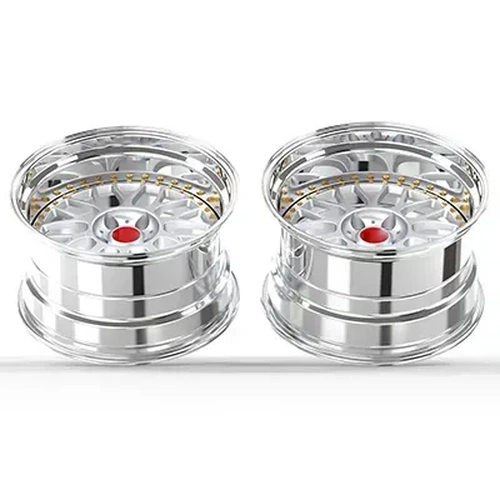
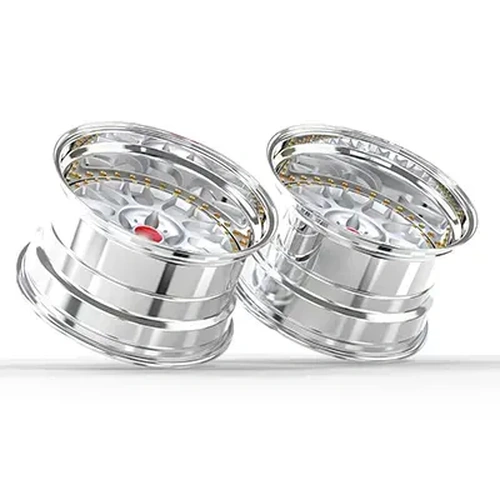
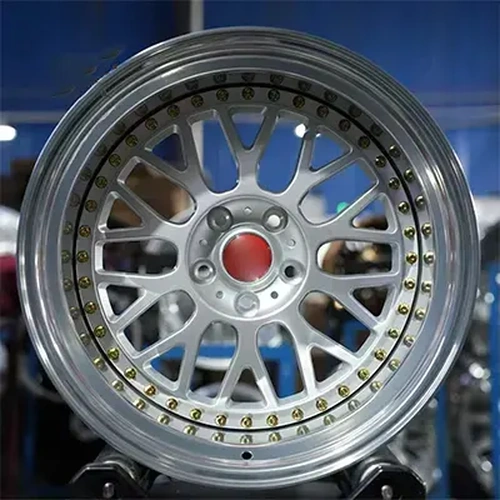
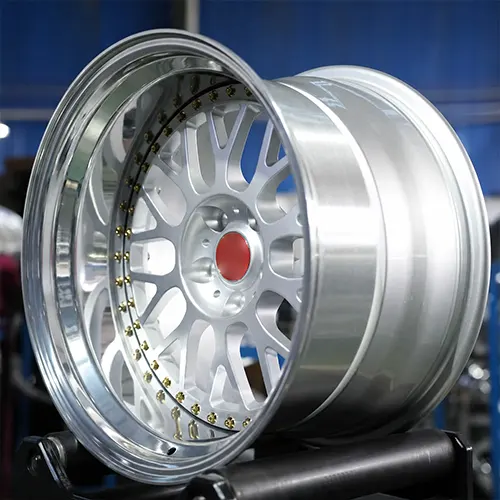
Fine Matte Silver mesh sits well inside a polished step lip, with gold rim bolts tracing the actual joint between the forged center and outer section. The depth is structural rather than simulated: 18×10.5 and 18×11 widths are combined with ET-31 and ET-25 geometry to create a pronounced two-piece profile. Finished weights remain at 10.3 kg and 10.1 kg, while the 750 kg load rating and dedicated mesh-concentricity inspection give the highly detailed design a clear engineering foundation.



Specifications
| Item | Specification |
| Model No. | RC065-41XT |
| Front Wheel Size | 18x10.5 |
| Rear Wheel Size | 18x11 |
| Front Offset (ET) | -31 |
| Rear Offset (ET) | -25 |
| Bolt Pattern (PCD) | 5x114.3 |
| Center Bore | 60.1 mm |
| Front Weight | 10.3 kg |
| Rear Weight | 10.1 kg |
| Load Rating | 750 kg |
| Construction | 2‑Piece Forged |
| Finish | Polished Outer Lip + Silver Inner Barrel + Matte‑Silver Mesh Center + Gold Rivets |
-
Descriptions

Engineering Notes
Fine mesh leaves very little room for inconsistency. Dozens of narrow interwoven spokes form one repeated radial pattern, so spoke position, straightness and concentricity have to remain controlled across the complete forged center. That requirement is reflected directly in the existing QC process, which includes a dedicated concentricity check on the mesh spokes.
The center is CNC-machined from a forged blank and assembled into a deep step-lip barrel with torque-controlled gold rim bolts. Wheel geometry is equally specific: 18×10.5 ET-31 at the front and 18×11 ET-25 at the rear. Existing Engineering Notes connect those wide, negative-offset dimensions with the barrel work required to create the deep-lip position while retaining suspension clearance.
Mounting dimensions are 5×114.3 PCD with a 60.1 mm center bore. Finished weights are listed at 10.3 kg front and 10.1 kg rear, with a 750 kg load rating.
The Mesh Has to Stay Visually Exact
What looks ornamental at first is actually one of the more demanding parts of the wheel.
Every spoke belongs to a larger pattern. If one section shifts, twists or loses concentricity, the error becomes visible through the surrounding mesh. That makes consistency across the complete center more important than simply producing an attractive individual spoke shape.
This is also why the wheel carries a stronger commercial story than a generic “classic mesh” description suggests. The appeal is not only the number of spokes, but the precision required to make the whole pattern read cleanly once assembled inside the polished lip.
Depth Comes From the Assembly
The polished outer lip is not a decorative ring laid over a shallow wheel.
A separate forged center sits inside the step-lip barrel, giving the wheel a real change in depth from mesh face to outer edge. Wide sections and substantial negative offsets make that relationship visible from a three-quarter angle, where the face appears noticeably recessed within the rim.
Gold rim bolts sit exactly at that transition. Their repeated pattern highlights the mechanical boundary between center and barrel, so the hardware becomes part of the design without pretending to be something it is not.
From Design to Delivery
Quality Verified
Two different areas require attention on this wheel: the mesh center must remain dimensionally consistent, while the assembled rim depends on controlled hardware, balance and final structural checks.
- Quality Verified 100% CMM dimensional inspection
- Dynamic balancing
- Concentricity check on mesh spokes
- Structural load testing (750kg rated)
- Torqued-to-spec rim bolts
- Multi-tone finish QC
Result
Mechanical detail is what gives the finished wheel its presence.
Matte Silver keeps the fine mesh controlled rather than overly reflective. Gold hardware then introduces a narrow accent around the perimeter before the eye reaches the polished step lip. As the viewing angle changes, the balance shifts from spoke detail to physical rim depth.
That layered appearance is backed by actual construction. The mesh is a forged center, the rim is part of a true two-piece assembly, and the pronounced lip follows the published width and negative-offset geometry.
The result feels classic without being generic: the familiar mesh language remains, but the proportions, hardware and depth give it a much stronger identity.

Want a classic mesh forged to your exact fitment?
Get a 2-piece setup tuned to your car's PCD, offset & lip depth
-
Build & Fitment
Negative Offset Is What Gives the Wheel Room to Look Deep
Deep lip is closely tied to where the mounting face sits within the wheel.
The 10.5-inch front uses ET-31, while the 11-inch rear uses ET-25. With both wheels already wide and both offsets well below zero, the center can sit much deeper within the surrounding rim than it would in a typical positive-offset package.
That relationship is what produces the visible step-lip depth. The appearance is therefore a consequence of wheel geometry, not something that can simply be added later as a styling option.
Front and Rear Follow Different Packaging Logic
The rear grows by half an inch in width, yet its offset becomes less negative.
That is an important detail because it prevents the setup from being reduced to the usual idea that “the rear is simply more aggressive.” Each axle combines width and offset differently.
The correct way to read the specification is as two complete wheel packages, each shaped around its own position relative to the hub, body and suspension.
Two-Piece Construction Makes the Lip Real
Separate center and rim sections allow the mesh face to sit at a depth determined by the final wheel geometry.
That gives the polished step lip a physical basis. Its depth comes from center position, barrel shape, width and offset rather than from a face profile designed to imitate a multi-piece wheel.
The gold rim bolts also belong to this assembly. Existing QC information specifically identifies them as torqued-to-spec hardware.
5×114.3 / CB60.1 Completes the Mounting Side
Fitment uses a 5×114.3 bolt pattern and 60.1 mm center bore.
The existing Engineering Notes describe the center bore as machined to the required tolerance for hub-centric mounting. That makes the bore part of the engineering specification rather than treating 5×114.3 alone as proof of compatibility.
Lip Depth Has to Be Recalculated When Fitment Changes
A buyer can retain the mesh design, polished lip or gold-hardware treatment without assuming the same wheel geometry will work on another vehicle.
Changing width, offset or available suspension space can alter how much step-lip depth is physically possible. For another IS250 configuration, the available fitment space can be checked before the wheel geometry is finalized.
-
FAQs
1. Is this a genuine two-piece forged wheel?
Yes. The forged mesh center is assembled with a separate rim section using torque-controlled rim bolts.
2. What wheel sizes are used?
The front measures 18×10.5 and the rear measures 18×11.
3. What offsets are specified?
The front uses ET-31 and the rear uses ET-25.
4. Why does this wheel have such a deep polished lip?
The deep profile comes from the combination of wide wheel sections, negative offsets and genuine two-piece construction.
5. Are the gold rivets only decorative?
No. The existing Engineering Notes identify them as gold rim bolts used in the two-piece assembly, and the QC list confirms that the bolts are torqued to specification.
6. Why is mesh concentricity checked separately?
The center contains many narrow interwoven spokes. Any variation can disrupt the repeated radial pattern, so concentricity is specifically included in the inspection process.
7. How much do the wheels weigh?
The published weights are 10.3 kg front and 10.1 kg rear.
8. Why is the wider rear listed slightly lighter?
Those are the values currently published on the page. No manufacturing explanation is provided, so they should remain as recorded rather than be interpreted without supporting data.
9. What load rating is specified?
The published structural rating is 750 kg per wheel.
10. What bolt pattern and center bore are used?
The wheel uses 5×114.3 PCD with a 60.1 mm center bore.
11. What finishes are used?
The specification lists a Polished Outer Lip, Silver Inner Barrel, Matte-Silver Mesh Center and Gold Rivets.
12. Can the same deep-lip profile be used with a different offset?
Not automatically. Lip depth changes with wheel width, offset, center position and available vehicle clearance, so the final geometry needs to be developed as one package.