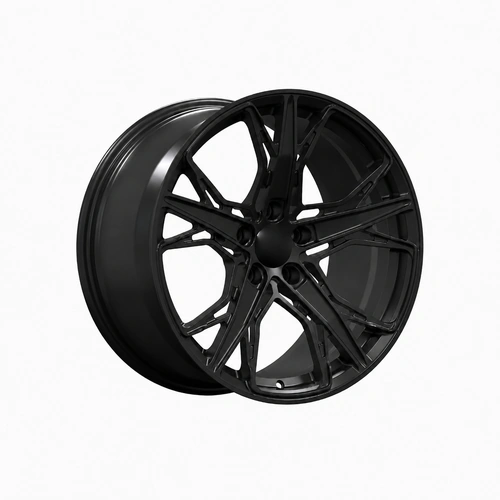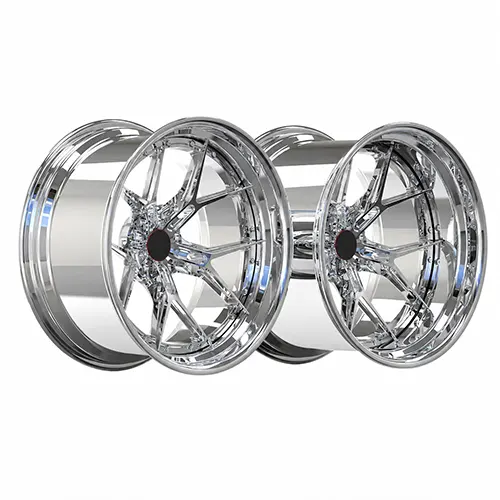
Staggered 21"/22" 2-Piece Forged Wheels for 2024 Porsche 911 Turbo S (992) | Chrome
- Model: RC157-9RC
Rear width defines this Turbo S wheel package before the chrome finish even enters the conversation. Front sizing starts at 21×9.5, then expands dramatically to 22×12.5 at the rear. Mirror chrome covers the visible surfaces, exposed hardware outlines the 2-piece construction, and the existing engineering specification accounts for PCCB ceramic brake clearance.


Specifications
| Item | Specification |
| Model No. | RC157-9RC |
| Construction | 2‑Piece Forged |
| Front Size | 21 × 9.5 |
| Rear Size | 22 × 12.5 |
| Front Offset | ET40 |
| Rear Offset | ET60 |
| Front Weight | 13.6 kg |
| Rear Weight | 16.3 kg |
| Load Rating | 750 kg |
| Finish | Chrome with Exposed Hardware Ring |
-
Descriptions

Engineering Notes
Ceramic brake hardware sets a hard boundary for the center geometry on this Turbo S. Large diameter alone does not guarantee sufficient room; spoke profile, inner shape and face position still need to clear the actual caliper package before the visible depth of the wheel can be finalized.
Front and rear dimensions then diverge dramatically. A 21×9.5 front keeps steering-axle proportions comparatively controlled, while the 22×12.5 rear creates three additional inches of width and substantially greater wheel volume.
Two-piece construction gives that rear specification more freedom than treating both axles as scaled versions of the same monoblock. Center position, barrel depth and outer section can be developed around each axle's dimensions while exposed hardware makes the assembly visually explicit.
Chrome comes last in that hierarchy. Mirror surfaces amplify the difference in depth between front and rear, but the geometry already exists before any polishing begins.
From Design to Delivery
Quality Verified
- 100% CMM dimensional inspection
- Dynamic balancing
- Structural load testing (750kg rated)
- Multi-stage chrome finish QC
Result
Three inches of additional rear width give this package its defining proportion. Chrome makes that difference easier to see, but PCCB clearance and axle-specific geometry are what make the specification work.

Building a Porsche 911 or other supercar?
-
Build & Fitment
Start With Brake Clearance, Not Chrome
Appearance may be what draws attention first, but PCCB clearance is the more important technical constraint.
Ceramic brake hardware occupies significant space behind the spokes, so face geometry has to work around the actual brake package before the final visual profile is approved.
A Three-Inch Width Difference
21×9.5 Front – ET40
The front remains comparatively narrow and controlled, giving the steering axle its own proportion rather than trying to mimic the rear.
22×12.5 Rear – ET60
Twelve and a half inches creates a very different rear wheel volume. Combined with the larger diameter, it gives the Turbo S the strongly rear-biased stance expected from this particular setup.
Why 2-Piece Construction Suits the Rear
A rear wheel this wide benefits visually from having a clearly defined center and outer section.
The fastener ring shows exactly where those components meet, while the chrome finish makes depth easier to perceive from an angle.
-
FAQs
1. Why is the rear wheel so much wider than the front?
The rear measures 12.5 inches wide compared with 9.5 inches at the front, creating the strongly rear-biased proportions of this wheel package.
2. What sizes and offsets are used?
Front fitment is 21×9.5 ET40; rear fitment is 22×12.5 ET60.
3. Does the design account for PCCB ceramic brakes?
Yes. The existing project specification includes clearance for the PCCB brake package.
4. Is the wheel a true 2-piece construction?
Yes. Separate forged components are assembled with visible hardware.
5. How much do the wheels weigh?
The front is listed at 13.6 kg, while the much wider rear is 16.3 kg.
6. Why is chrome demanding to finish?
A highly reflective surface makes small inconsistencies, polishing marks and transitions easier to see than many painted finishes.
7. Can another 992 use the same rear dimensions?
Not automatically. Brake configuration, suspension, tire choice and required stance should be checked before copying the specification.
More Forged Wheel Cases