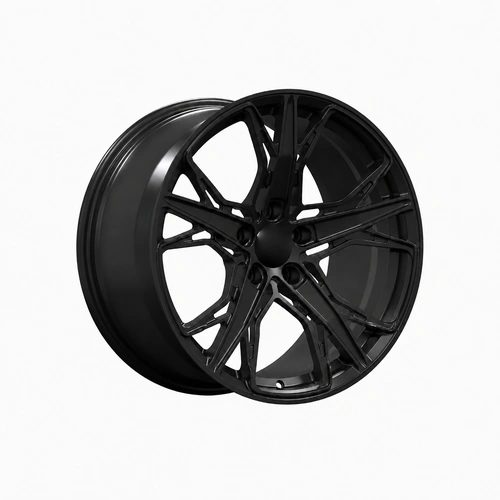
2012 Toyota FJ Cruiser — Gloss Black Web Spoke with Carbon Fiber Lip Wrap and Trail Teams Green Accent Forged Monoblock (24×10 Overland Show Build)
- Model: RC1138-3XT (2410)
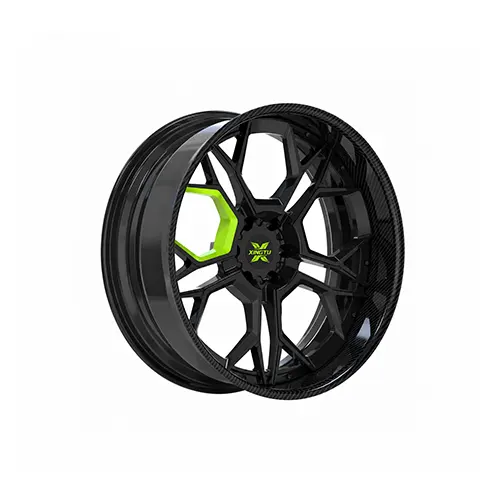
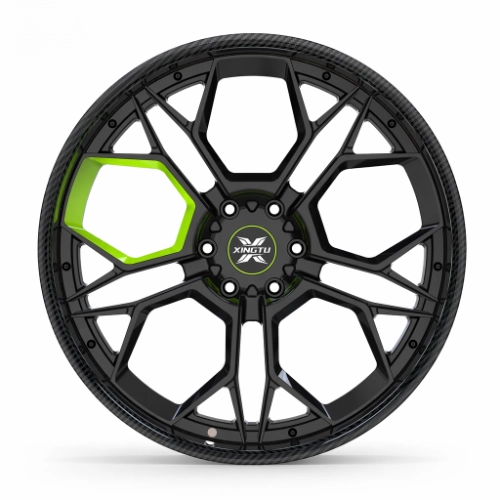
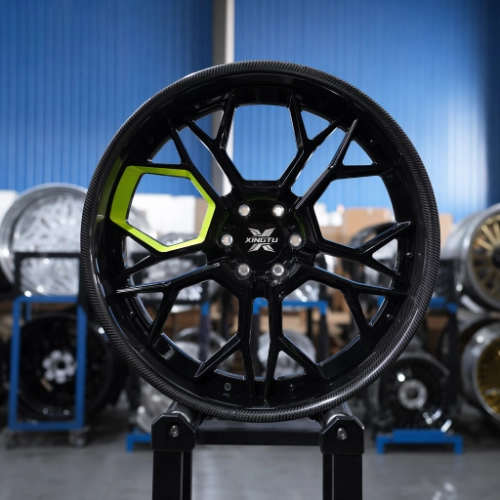
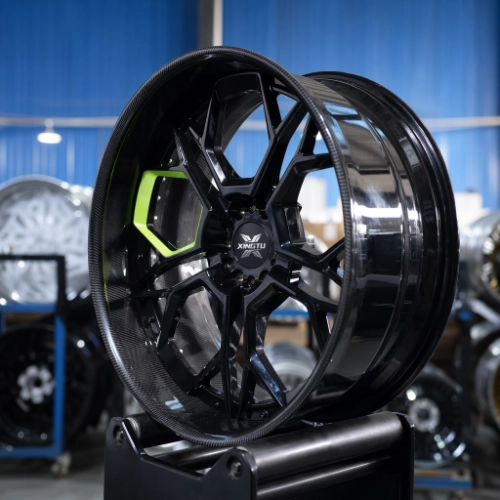
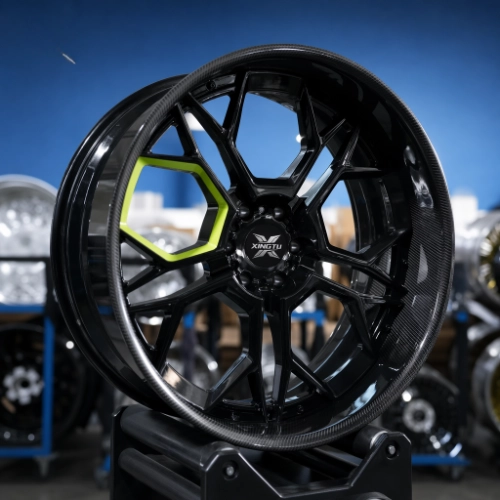
A 2012 Toyota FJ Cruiser owner came to XINGTU wanting a full show-piece wheel that would set the FJ apart from every stock and lift-kit build in the paddock — a deep gloss black web-spoke face wrapped by a carbon fiber outer lip, with a single hexagonal window highlighted in the FJ Cruiser Trail Teams signature fluorescent green as a color callout. The build was specified as 24×10 with an aggressive deep-negative ET-47 offset, forged monoblock, matched to the FJ's OEM 6×139.7 body-on-frame hub. Because ET-47 pushes the wheel far outboard of the FJ's factory position, XINGTU built strictly to the customer-submitted fitment on the understanding that the vehicle already runs a wide-arch / lift setup to receive it.



Specifications
| Item | Specification |
| Model No. | RC1138-3XT (2410) |
| Size | 24×10 inch |
| PCD | 6×139.7 mm |
| Offset (ET) | ET-47 (deep negative offset) |
| Center Bore | 106.1 mm |
| Weight | 17.8 kg |
| Load Rating | 900 kg per wheel |
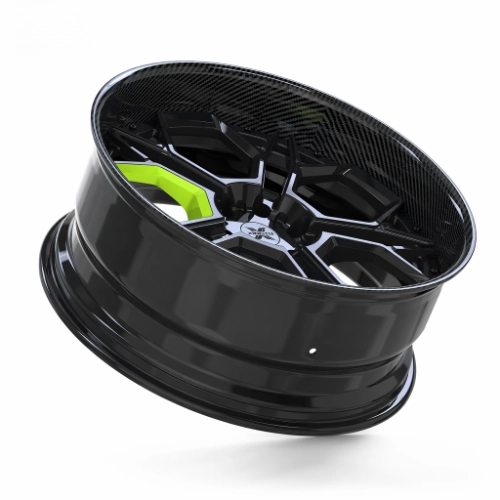
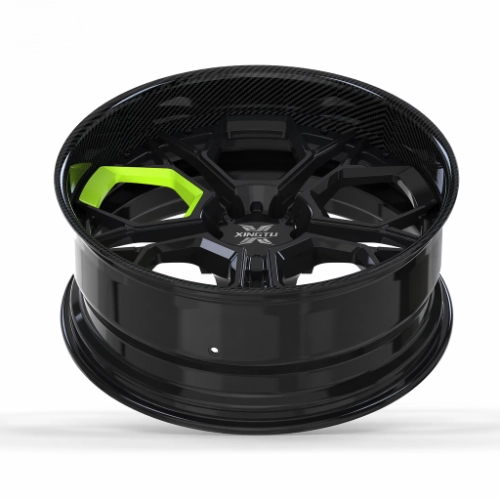
| Finish | Gloss Black center + Gloss Black barrel + Carbon Fiber Lip Wrap + Trail Teams Green single-window accent |
| Center Cap | Custom XINGTU cap fitted on the final wheel (customer-provided FJ Cruiser cap shown on 3D render only) |
| Construction | Forged Monoblock |
| Lead Time | 45 days (monoblock + carbon fiber wrap + multi-color paint pipeline) |
-
Descriptions

Engineering Notes
All of the finish complexity sits over a relatively simple structural core.
The web-spoke face, hub and barrel remain one continuous 6061-T6 forged monoblock. At 24×10, the completed wheel weighs 17.8 kg and carries a 900 kg rating.
The outer carbon treatment is deliberately kept outside that structural story. It is a real carbon-fiber decorative sleeve applied over the lip for material contrast, while the aluminum underneath continues to carry the wheel load.
Fitment follows customer-submitted 24×10 ET-47 geometry with 6×139.7 PCD and a 106.1 mm center bore. ET-47 assumes an FJ Cruiser already prepared around the resulting outboard wheel position.
Controlled Asymmetry Gives the Face Its Signature
The most effective design detail occupies one of the smallest areas.
Only one hexagonal opening receives the Trail Teams Green accent. Because every surrounding section remains Gloss Black, the eye immediately finds that one interruption in the web pattern.
Repeating green around every opening would create a black-and-green color scheme. Using it once creates an identifiable design signature.
That distinction gives the wheel considerably more sophistication than simply maximizing the amount of custom color.
Carbon Is Used for What Carbon Does Visually
The outer lip does not need carbon fiber for structural capacity.
Its value is texture.
The visible weave reacts to light in a completely different way from Gloss Black paint, giving the wheel a material change around the perimeter without introducing another large color block.
Adhesion and edge sealing therefore become the relevant production concerns for the carbon layer, while structural inspection remains focused on the forged aluminum underneath.
Web-Spoke Geometry Holds the Finish Together
The face itself is already visually active.
Intersecting web-like sections create a network across the 24-inch wheel, which means additional customization has to be carefully controlled. Gloss Black allows much of that geometry to recede until light catches the spoke edges.
Carbon then frames rather than competes with the web. Green marks one location rather than decorating every opening.
The result is a multi-process wheel where the architecture remains readable.
Three Finish Processes, Three Different Jobs
Gloss Black establishes continuity across the forged body.
Carbon fiber provides perimeter texture.
Trail Teams Green supplies the focal point.
Their areas are deliberately unequal, which is exactly why the composition works. A highly customized wheel does not need every feature to compete for attention.
From Design to Delivery
Quality Verified
The forged structure and the decorative treatments require different inspection criteria. Dimensional accuracy, runout and structural integrity belong to the monoblock; paint consistency, green color matching, carbon adhesion and edge sealing are evaluated as separate finish operations.
- CMM dimensional inspection (PCD / CB / runout)
- Dynamic balancing on every wheel (≤5 g)
- Forged 6061-T6, hub-centric machining verified X-ray + dye-penetrant
- NDT on every wheel Gloss black wet paint color match, gloss uniformity & clear coat cure verified
- Trail Teams green accent color match under standard D65 lighting
- Carbon fiber lip wrap adhesion + edge seal inspection
Result
The wheel is unmistakably custom, but it does not look randomly customized.
Gloss Black lets the web-spoke architecture establish the main form. Carbon changes the material character at the perimeter without taking over the wheel. One green opening then provides a precise visual signature that can be recognized almost immediately.
Underneath those details, 17.8 kg finished mass and a 900 kg rating keep the 24-inch design grounded in a defined forged structure.
That balance between restraint and customization is the real commercial strength of the wheel.

Building an FJ Cruiser, 4Runner, Land Cruiser, Tacoma, or any 6×139.7 body-on-frame Toyota show truck with already-modified arches?
XINGTU forges to your exact submitted fitment—including 22"–26" diameters, deep-negative offsets, painted / carbon-wrapped / multi-color finishes, and factory-color callouts like FJ Cruiser Trail Teams Green.
-
Build & Fitment
ET-47 Is Integral to the Show-Build Package
A 24×10 wheel at ET-47 sits far farther outward than a conventional FJ Cruiser wheel position.
The specification assumes the vehicle has already been prepared around that geometry rather than expecting the wheel to fit an otherwise standard body.
Arch and Suspension Clearance Need to Be Confirmed First
Wide or flared arches and appropriate suspension height are part of the vehicle-side preparation associated with this type of fitment.
Steering-lock and inner-fender clearance also need to correspond with the final tire and wheel package before dimensions are treated as production-ready.
6×139.7 / CB106.1 Defines the Hub Side
The wheel retains a 6×139.7 bolt pattern with a 106.1 mm center bore.
The bore provides the defined hub-centric interface even though the wheel's ET position is highly customized.
Carbon Fiber Does Not Change Wheel Geometry
The decorative lip sleeve adds no structural width, offset or load capability to the wheel.
Fitment is determined by the forged aluminum underneath—diameter, section width, offset, bolt pattern and center bore—not by the carbon treatment applied later.
Finish Customization and Fitment Customization Are Separate Decisions
A different FJ Cruiser can retain the Gloss Black web-spoke face, carbon lip and single accent concept without copying ET-47.
This is an important distinction for custom orders: the visual identity can be preserved while the forged blank is machined around another confirmed wheel position.
Vehicle Modifications Should Be Resolved Before Production
For a similar wide-stance FJ build, final arch, suspension, steering and hub information should be known before machining begins.
XINGTU can develop the wheel geometry around the confirmed vehicle package rather than using the finished appearance as a substitute for fitment data.
-
FAQs
1. Is the carbon-fiber lip part of the structural wheel?
No. The carbon fiber is a real decorative sleeve applied to the outer lip. Structural loads remain within the forged 6061-T6 monoblock underneath it.
2. Why use only one Trail Teams Green opening?
Restricting the accent to one hexagonal window creates a recognizable focal point while preserving the web-spoke architecture. Repeating the color across the whole face would change the design from a controlled accent into a conventional two-color scheme.
3. What construction is used beneath the finishes?
Hub, spoke face and barrel form one forged monoblock rather than a multi-piece assembly.
4. How much does the 24×10 wheel weigh?
Finished mass is 17.8 kg per wheel.
5. What structural rating is specified?
Each wheel is rated to 900 kg.
6. Is 24×10 ET-47 suitable for a stock FJ Cruiser?
No. ET-47 belongs to a customer-submitted show-build configuration and assumes the vehicle has already been prepared for the resulting wheel position.
7. What vehicle-side changes need to be considered with this kind of fitment?
Arch width, suspension height and geometry, steering-lock clearance and inner-fender space need to correspond with the intended wheel and tire package.
8. What hub dimensions are used?
The wheel uses 6×139.7 PCD and a 106.1 mm center bore.
9. Does the carbon sleeve affect offset or load capacity?
No. It is applied after the forged wheel geometry has been established and does not alter the structural specification.
10. Can the same black/carbon/green design be used with a different offset?
Yes. Finish design and fitment geometry can be developed separately. Another FJ Cruiser can retain the same visual concept while using dimensions suited to its own suspension and arch package.
11. Can the Trail Teams Green accent be moved to another opening?
The finish is customizable, so the location can be developed as part of the visual specification. Keeping the accent limited to a small area is what preserves the controlled character of the design.
12. What needs to be confirmed before placing a custom order for a similar wheel?
The most useful information is the actual vehicle configuration: desired diameter and width, confirmed hub dimensions, intended wheel position and any relevant arch or suspension modifications. Those details allow the forged geometry to be developed before the finish treatment is applied.
Related Products