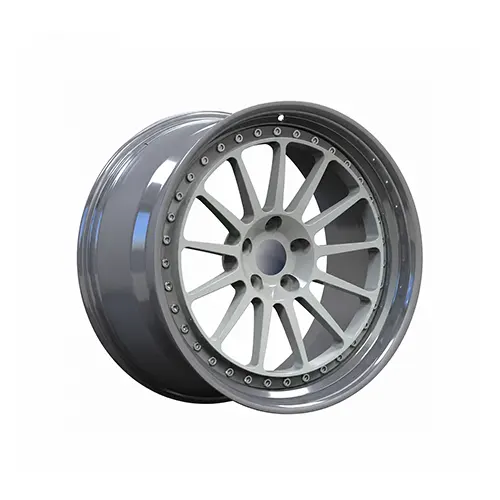
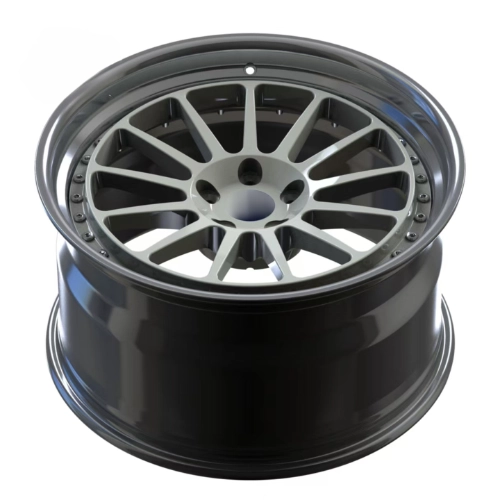
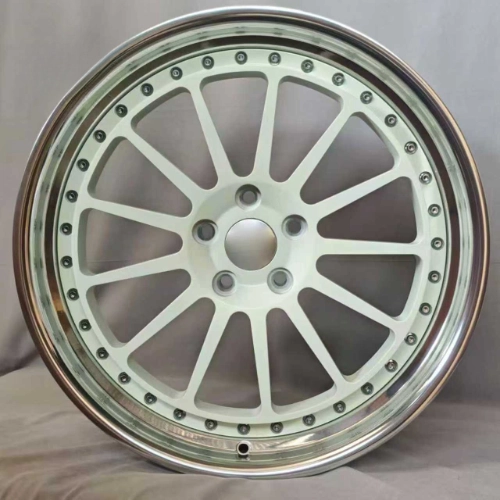
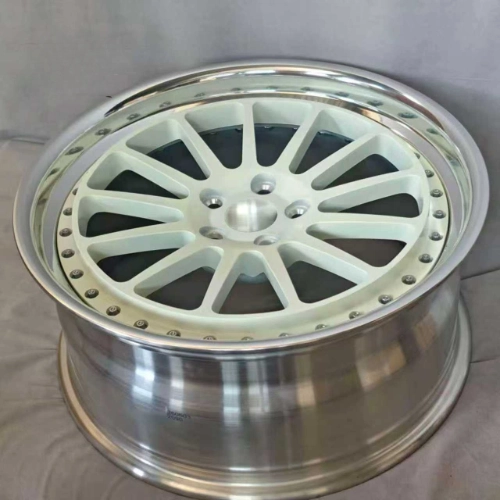
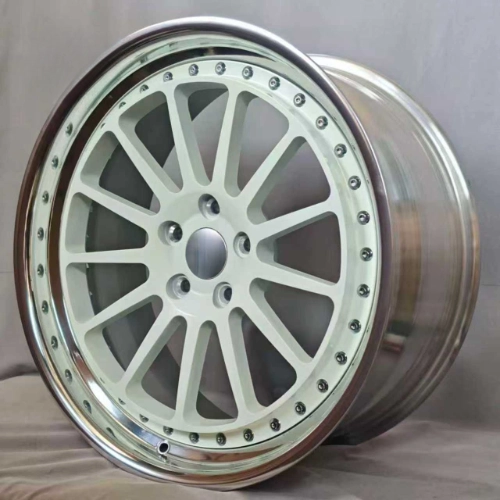
20×9.0 / 20×11.0 Forged Two-Piece Wheels for 2014 Ferrari 458 Italia – Eggshell Cream 14-Spoke Center with High-Polish Silver Deep-Lip Barrel 5×114.3
- Model: GD260603-2090-2011
A 2014 Ferrari 458 Italia owner came to XINGTU wanting to move away from the OEM Ferrari 5-spoke look and asked for a retro motorsport 14-spoke design — the kind of period-correct face you see on classic Gulf-era GT racers — finished in a soft eggshell cream center against a bright high-polish silver barrel with visible barrel bolts. The build was specified as a staggered 20×9.0 front / 20×11.0 rear, forged two-piece for the deep-lip stance the 458's arches were designed around, on customer-submitted fitment: 5×114.3 / CB67.1 / ET25 front / ET30 rear. XINGTU built strictly to the customer-provided numbers on the understanding that the vehicle has been configured to accept this bolt pattern (see engineering note below).


Specifications
| Item | Specification |
| Model No. | GD260603-2090-2011 |
| Front Size | 20×9.0 inch |
| Rear Size | 20×11.0 inch |
| PCD | 5×114.3 mm |
| Front ET | 25 |
| Rear ET | 30 |
| Center Bore | 67.1 mm |
| Weight per Wheel | 13.8 kg |
| Load Rating | 900 kg |
| Lug Seat | 15×32×60° taper long shank |
| Center Finish | Eggshell Cream painted |
| Barrel Finish | High‑Polished Silver mirror |
| Construction | Forged Two‑Piece |
| Lead Time | 45 days |
-
Descriptions

Engineering Notes
The two-piece architecture has a practical role in the proportion of this wheel.
The center is machined from forged 6061-T6 aluminum, while a separate barrel provides the outer section required by the staggered 20×9 front and 20×11 rear. That separation lets the rear gain meaningful lip depth without forcing the center design itself to become artificially recessed.
Assembly is equally important. Perimeter bolts are tightened to specification, the joint is sealed with an O-ring, and the completed wheel is pressure-tested for airtightness before final finishing and delivery.
A 900 kg per-wheel load rating provides the structural reference for the finished assembly.
Fourteen Spokes Create Fineness Without Looking Fragile
The center uses spoke count to create refinement rather than visual aggression.
Fourteen slender sections distribute detail evenly around the hub and give the wheel a much finer cadence than a five- or six-spoke design. The center remains open enough for the individual spoke paths to stay readable, while the higher count gives the wheel its distinctive GT-inspired character.
Eggshell Cream is particularly effective here because it does not compete with the spoke geometry. The softer color keeps the dense center visually calm and allows the surrounding polished metal to provide the brighter highlight.
Visible Hardware Has a Mechanical Reason to Exist
Perimeter bolts are not decorative rivets added to imitate a multi-piece wheel.
They connect the forged center to the separate barrel, making the hardware an honest expression of how the wheel is built. The bolted joint then receives sealing and pressure verification as part of assembly.
That relationship between visible detail and actual construction is one of the strongest commercial qualities of the design. Customers are not simply buying a “multi-piece look”; the wheel genuinely possesses the component architecture that creates it.
Polished Aluminum Gives the Barrel a Different Material Character
The barrel is precision-machined and polished rather than chrome plated.
Its reflection therefore belongs to the aluminum itself, creating a warmer metallic contrast against the painted Eggshell Cream center. Clear protection is applied after polishing to preserve the finished surface.
The transition from painted forged center to polished barrel follows a real component boundary, which makes the two-tone treatment feel integral to the construction rather than applied arbitrarily.
From Design to Delivery
Quality Verified
Two-piece integrity requires more than dimensional inspection. Bolt-joint torque, O-ring sealing and pressure testing determine whether the assembly remains mechanically secure and airtight, while the center color and polished barrel require their own finish controls.
- CMM dimensional inspection (PCD / CB / runout)
- Dynamic balancing on every wheel (≤5 g)
- Forged 6061-T6 center, hub-centric machining verified
- X-ray + dye-penetrant NDT on every wheel
- Two-piece bolt joint torque + o-ring seal + airtight pressure test
- Eggshell cream color match under standard D65 lighting
- Polished barrel mirror surface finish inspection
- Hub-centric ring included for OEM Ferrari hub sizing
Result
The finished wheel earns its classic influence through construction rather than decoration.
A forged fourteen-spoke center gives the wheel its visual rhythm. A real separate barrel creates the depth. Functional perimeter hardware makes the assembly legible, and the contrast between Eggshell Cream and polished aluminum emphasizes those component boundaries.
The wider rear wheel simply gives the architecture more room to express itself. That is why the design feels purposeful rather than nostalgic for nostalgia's sake.

Running a Ferrari 458 / 488 / F8, McLaren 12C / 570S / 720S, or any modern mid-engine supercar and want a period-correct multi-spoke motorsport face with custom color?
XINGTU forges to your exact fitment—including deep-lip two-piece construction, custom wet-paint color matching, and precision-polished barrels.
-
Build & Fitment
Front and Rear Use Different Barrel Requirements
The front is 20×9 ET25, while the rear increases to 20×11 ET30.
The extra two inches of rear width allow a significantly larger outer section to be incorporated without redesigning the basic fourteen-spoke language. The stagger therefore changes the wheel's physical depth more than its visual identity.
The Submitted Hub Specification Is Part of This Build
Fitment was produced around 5×114.3 PCD and a 67.1 mm center bore supplied for the vehicle configuration.
A hub-centric ring forms part of the final centering arrangement. That detail should remain associated with this specific wheel package rather than being generalized to every 458.
Center Position and Barrel Depth Need to Be Developed Together
On a two-piece wheel, lip depth is not an isolated cosmetic choice.
Center position, wheel width, ET and the required inboard space all influence how much outer barrel can be exposed. Asking for “more lip” without reviewing those dimensions can alter the entire fitment.
The Bolted Joint Must Also Remain Airtight
Wheel assembly does not finish once the perimeter hardware reaches its torque specification.
The O-ring seals the interface between center/barrel assembly components, followed by pressure testing to verify airtightness before the wheel is released.
This is especially important for B2B customers evaluating genuine multi-piece construction, because joint integrity is a production requirement rather than a visual detail.
A Different 458 Setup Can Retain the Design Without Copying the Dimensions
The fourteen-spoke center, Eggshell Cream color and polished-barrel concept can be carried into another specification.
Width, offset, hub arrangement and final lip depth still need to be resolved around the actual vehicle. XINGTU can confirm the mounting package before the center and barrel dimensions are released for machining.
-
FAQs
1. Is this a genuine two-piece forged wheel?
Yes. A forged 6061-T6 center is assembled with a separate barrel using perimeter hardware. The construction is not a monoblock styled to resemble a multi-piece wheel.
2. Are the visible perimeter bolts functional?
Yes. They form part of the center-to-barrel assembly and are tightened to specification during production.
3. How is the two-piece joint kept airtight?
An O-ring is used to seal the assembly, followed by an airtight pressure test before final release.
4. Why does the rear wheel have more lip depth?
Rear width increases from 20×9 to 20×11. The additional section width gives the two-piece architecture more room to create a deeper outer barrel while retaining the same basic center design.
5. Is the polished silver barrel chrome plated?
No. It is precision-machined aluminum polished to a mirror-level finish rather than chrome plating.
6. Why use Eggshell Cream on a fourteen-spoke center?
The softer off-white tone keeps the high-count face visually controlled and provides a clear material contrast with the polished aluminum barrel without overpowering the spoke geometry.
7. What front and rear offsets are used?
ET25 is used at the front and ET30 at the rear.
8. What load rating is specified?
Each wheel carries a 900 kg rating.
9. What does the CB67.1 specification mean for another Ferrari 458 order?
It belongs to the confirmed mounting arrangement used for this build, including the hub-centric ring. A new order should be based on the actual vehicle's verified hub configuration rather than automatically reusing CB67.1.
10. Can the same fourteen-spoke design be produced with a different barrel depth?
Yes, provided the new width, offset and available vehicle clearance support it. Barrel depth should be developed as part of the complete fitment rather than selected independently.
Related Products