20" Deep-Lip Forged Wheels for 2023 Dodge Charger SRT | Full Polished
- Model: RC1069-3XXT
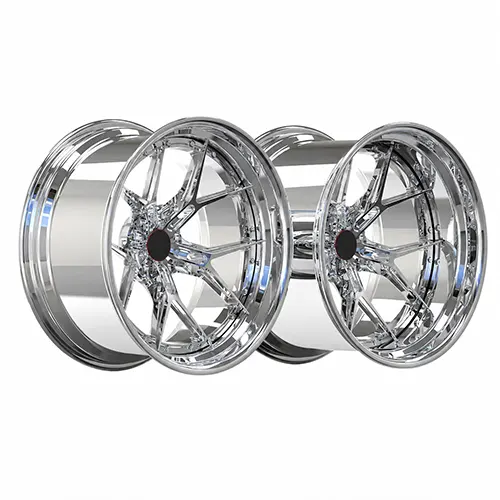
Mirror polish makes the deep lip impossible to miss on this Charger SRT. Five broad spokes leave large openings across the face, while exposed fasteners trace the inner edge of the outer section. Every wheel is 20×11, yet different front and rear offsets—ET-2.5 and ET-10—give the two axles distinct positions despite sharing the same diameter and width.


Specifications
| Item | Specification |
| Model No. | RC1069-3XXT |
| Construction | Multi‑Piece Deep‑Lip Forged |
| Size | 20 × 11 (all four) |
| PCD | 5 × 115 |
| Front Offset | ET‑2.5 |
| Rear Offset | ET‑10 |
| Center Bore | 71.6 mm |
| Front Weight | 12.9 kg |
| Rear Weight | 13 kg |
| Load Rating | 750 kg |
| Finish | Full Polished with Exposed Hardware |
-
Descriptions

Engineering Notes
Equal width does not mean equal fitment on this Charger. Both front and rear measure 20×11, but offset changes from ET-2.5 at the front to ET-10 at the rear. That difference pushes the rear wheel farther outward and contributes directly to the deeper, more rear-biased stance shown in the finished set.
Current specifications record a 5×115 PCD, 71.6 mm center bore and 750 kg load rating. Front weight is 12.9 kg and rear weight is 13 kg, keeping the two axle-specific wheels very close in mass.
Brembo clearance is already part of the existing engineering description and should remain. Deep-lip appearance alone does not determine whether the wheel works around a large brake package; spoke profile and internal space still have to follow the approved geometry.
Full polishing turns nearly every visible surface into part of the finish. Spokes, lip and exposed-hardware area all catch strong reflections, so surface preparation becomes far more noticeable than it would under a matte coating.
From Design to Delivery
Quality Verified
- 100% CMM dimensional inspection
- Dynamic balancing
- Structural load testing (750kg rated)
- Hand-polished finish QC
Result
Depth is the first thing the finished wheel communicates. Wide 11-inch barrels give all four corners substantial presence, while the more negative rear offset makes the back of the car appear even broader.
Five simple spokes keep that depth visible instead of covering it with a dense mesh face. Mirror polish then exaggerates every curve and edge, giving the wheel a far more dramatic appearance than the same geometry would have in black.

Building a Dodge Charger, Challenger, or other muscle car?
-
Build & Fitment
Same Width, Different Position
This setup offers a useful example of why wheel width alone never tells the full fitment story.
Both axles run 20×11, yet ET-2.5 front and ET-10 rear position those wheels differently relative to the hub.
Deep Lip Comes From Geometry
A deep outer profile is not simply a cosmetic ring added to the wheel.
Width, face position and offset all contribute to the amount of visible depth available. The more negative rear ET figure strengthens that effect without changing the nominal 20×11 size.
Five Spokes Leave the Lip Exposed
Dense mesh would visually cover much of the barrel behind the face. Five broad spokes do the opposite.
Large openings make the deep polished section easy to see, particularly from angled views, and also keep the exposed hardware clearly visible.
Full Polish Needs Restraint Elsewhere
With every major metal surface reflecting light, adding multiple paint colors would change the character completely.
Keeping the wheel monochrome lets the contrast come from shape—flat spoke surfaces, recessed hardware and the curved deep lip all reflect differently.
When another Charger has a different brake package or stance, owners can share the vehicle setup with Xingtu before offset and face position are finalized.
-
FAQs
1. Are all four wheels 20×11?
Yes. Width and diameter remain the same front and rear.
2. Why do the offsets differ if the wheel sizes are identical?
ET-2.5 front and ET-10 rear change the wheel position at each axle and contribute to the deeper rear stance.
3. What bolt pattern is used?
The listed PCD is 5×115 with a 71.6 mm center bore.
4. Does this wheel clear Brembo brakes?
The current Engineering Notes state that the fitment preserves clearance for the Charger's Brembo brake package.
5. How much do the wheels weigh?
Front weight is listed at 12.9 kg and rear weight at 13 kg.
6. What makes this a deep-lip design?
Wheel width, face position and negative offset combine to create the visibly deep outer section.
7. Can the wheel use a non-polished finish?
Yes. Another surface treatment can be selected when a less reflective appearance is preferred.
More Forged Wheel Cases