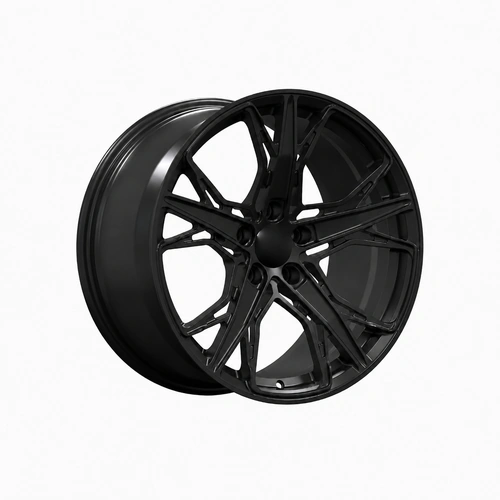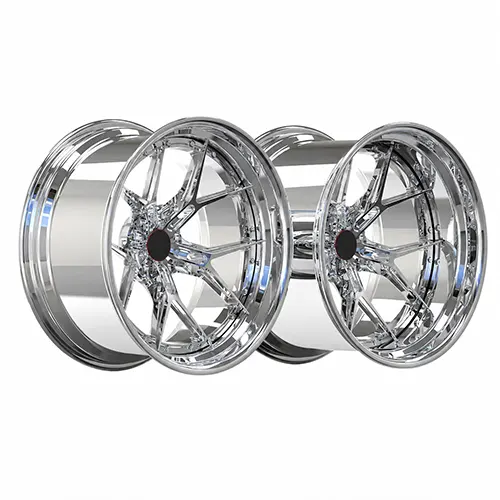
2017 Chevrolet Corvette C7 | Staggered 19"/20" Forged Monoblock · Chrome Polished
- Model: RC079-35XT
Low finished mass is what makes this C7 set worth noticing. Chrome may provide the immediate visual impact, but the engineering numbers are more compelling: 9.5 kg for the 19×10 front and 10.7 kg for the much wider 20×12 rear. Open split spokes leave plenty of negative space across the face, allowing the mirror-polished monoblock to look sharp and light rather than like a solid chrome disc.


Specifications
| Item | Specification |
| Model No. | RC079-35XT |
| Construction | Forged Monoblock, 6061‑T6 Aluminum |
| Front Size | 19 × 10 |
| Rear Size | 20 × 12 |
| PCD | 5 × 120.65 |
| Front Offset | ET40 |
| Rear Offset | ET59 |
| Center Bore | 70.3 mm |
| Front Weight | 9.5 kg |
| Rear Weight | 10.7 kg |
| Load Rating | 750 kg |
| Finish | Chrome Polished |
-
Descriptions

Engineering Notes
Mass deserves to lead this description because the finished figures are unusually strong for the recorded dimensions. Front specification is 19×10 ET40 at 9.5 kg. Rear specification grows to 20×12 ET59 yet remains at 10.7 kg. Both carry the 750 kg load rating listed on the page.
Forged monoblock construction keeps the wheel visually and structurally simple. No fastener circle divides the face, no separate rim section interrupts the polish, and the split spokes flow directly into the forged barrel. That uninterrupted form is particularly effective under a reflective finish because every transition remains visible.
Chrome-bright polishing is far less forgiving than an opaque coating. Surface waviness, machining marks and inconsistent transitions become obvious when reflections move across the wheel. Existing Engineering Notes already identify surface preparation as a demanding part of this finish, which gives the page a more credible technical angle than describing chrome only as a styling choice.
Hub data is recorded at 5×120.65 with a 70.3 mm center bore. Offset changes significantly front to rear, matching the change from a 10-inch front wheel to a 12-inch rear rather than repeating one geometry across both axles.
From Design to Delivery
Quality Verified
Surface quality carries unusual weight on this project because mirror polish exposes the forged face rather than concealing it. Dimensional inspection is equally axle-specific: front and rear differ in diameter, width and offset.
- CMM dimensional inspection on PCD, bore & offset
- Mirror-chrome surface inspected for flawless finish
- Dynamic balancing on every wheel
- Load-rated to 750kg per wheel
Result
Numbers and appearance support each other here instead of competing.
Chrome gives the wheel the brightness expected from a polished show finish, yet the 9.5 / 10.7 kg recorded masses prevent the set from becoming a purely cosmetic story. Wider 20×12 rear dimensions add considerable volume, while the open monoblock face keeps that scale visually light.

Own a Corvette, Camaro, or other 5x120.65 GM performance car?
Get a custom forged set in your exact size & finish
-
Build & Fitment
Start With Finished Mass
“Lightweight” is easy to write and difficult to prove. This page already has the better argument: 9.5 kg front, 10.7 kg rear.
Those figures give visitors something concrete to evaluate without surrounding the wheel with exaggerated claims about vehicle response.
Rear Geometry Is Not a Small Variation
Front configuration is 19×10 ET40. Rear configuration becomes 20×12 ET59.
Diameter, width and offset all change, making the rear a genuinely axle-specific wheel rather than a slightly enlarged front design.
Mirror Polish Needs Open Geometry
Broad openings between the split spokes stop reflected light from overwhelming the complete face.
Instead, polished surfaces remain separated by negative space, letting each spoke show its curvature and machining independently.
Why Monoblock Matters Visually
No exposed assembly hardware breaks the perimeter. That cleaner construction gives chrome one continuous forged surface to work across and keeps attention on proportion rather than component separation.
Another C7 configuration can be reviewed with Xingtu when wheel width, offset or finish direction changes.
-
FAQs
1. How much do these Corvette C7 forged wheels weigh?
Front weight is listed at 9.5 kg; rear weight is 10.7 kg.
2. What sizes are used?
19×10 front and 20×12 rear.
3. What offsets are specified?
ET40 front and ET59 rear.
4. Is this a 2-piece wheel?
No. Current specifications identify forged monoblock construction.
5. Why is mirror polishing demanding?
Highly reflective metal makes machining marks, uneven transitions and surface waviness much easier to detect than an opaque coating.
6. What load rating does the wheel carry?
The listed rating is 750 kg per wheel.
7. Can the wheel be finished in something other than chrome?
Yes. Finish choice can change independently from the fitment geometry when another C7 specification is developed.
More Forged Wheel Cases