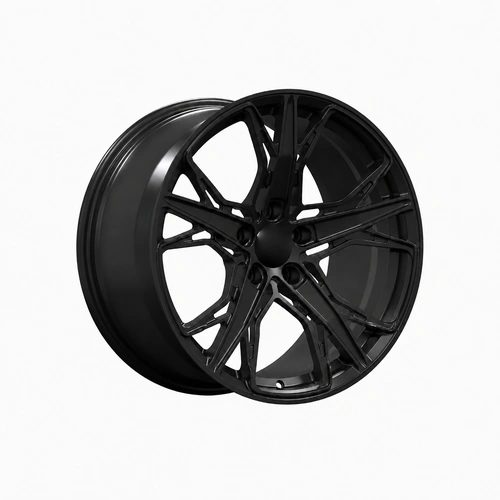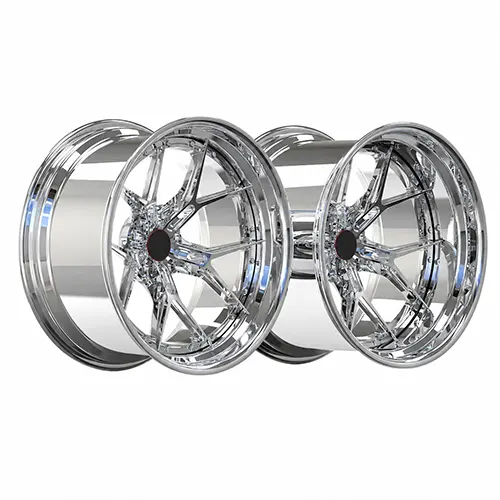
2015 Cadillac Escalade — Polished Face with Gloss Blue Barrel Forged Monoblock (24x14 Ultra-Wide Show Build)
- Model: RC1300-1XXT (2414)
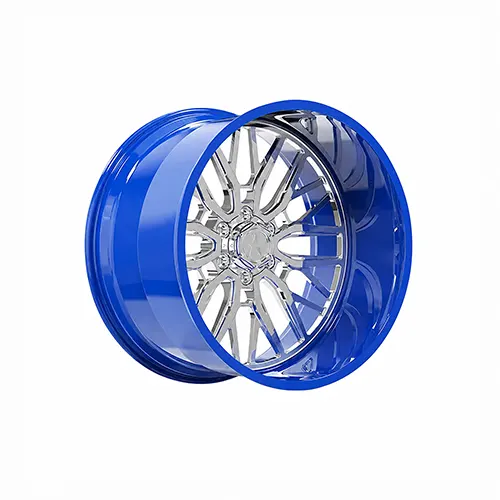
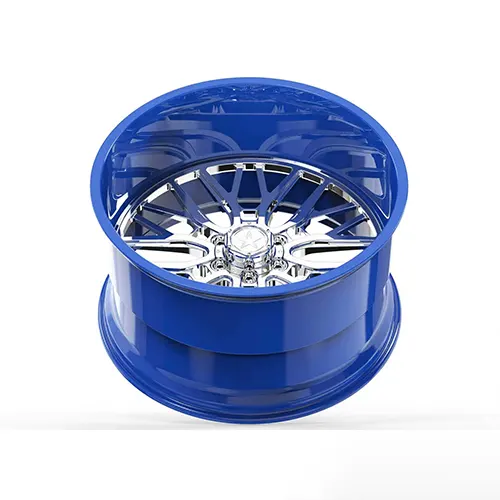
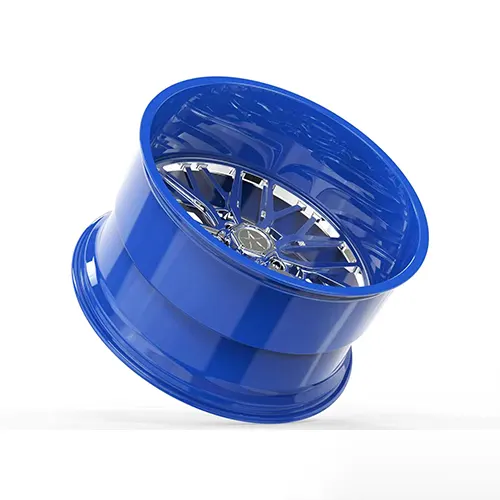
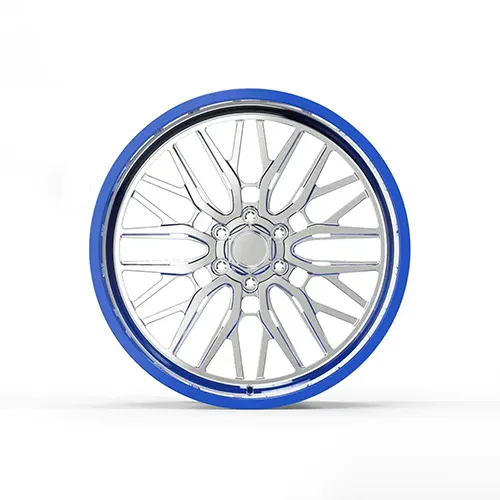
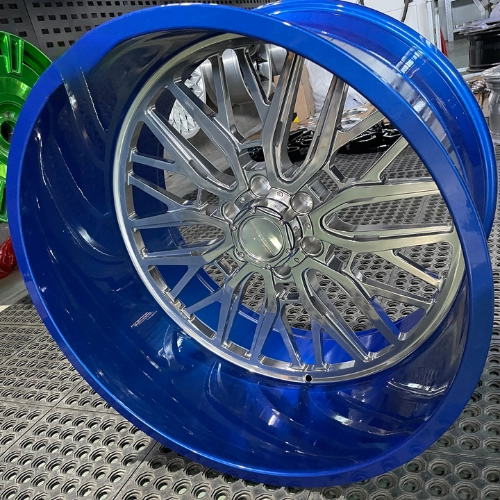
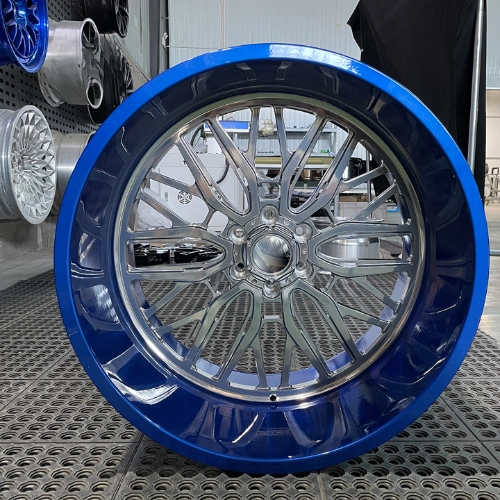
Combined with ET-76, the 24-inch monoblock develops an exceptionally large outer section and sits far outside conventional Escalade geometry. The forged 6061-T6 structure keeps the completed wheel at 19 kg while carrying a 1,100 kg rating. CNC-polished aluminum concentrates reflection across the multi-spoke face; Gloss Blue then carries color through the vast barrel, making the physical scale immediately visible.



Specifications
| Item | Specification |
| Model No. | RC1300-1XXT (2414) |
| Size | 24x14 inch |
| PCD | 6x139.7 mm |
| Offset (ET) | ET-76 (deep negative) |
| Center Bore | 78.1 mm |
| Weight | 19 kg |
| Load Rating | 1100 kg per wheel |
| Finish | CNC polished face + gloss blue painted outer barrel (two-process) |
| Construction | Forged Monoblock |
-
Descriptions

Engineering Notes
A 24×14 wheel with ET-76 operates in a very different packaging envelope from a conventional Escalade wheel. The dimensions were supplied for a vehicle already configured around the required width, outboard position and clearance, so the forged blank was machined to the confirmed build rather than adapted from a generic SUV fitment.
What gives the specification engineering substance is the relationship between size, mass and load capacity. Despite the 14-inch section width, the completed monoblock weighs 19 kg and carries a 1,100 kg per-wheel rating. Hub, multi-spoke center and barrel remain one continuous 6061-T6 forged structure, with a 78.1 mm center bore machined around the confirmed hub interface.
The visual complexity is created later in production. The center face is CNC-polished directly on the forged aluminum, while the barrel follows a separate Gloss Blue paint sequence with surface preparation, base color, clear coats and controlled curing.
The Barrel Has Enough Scale to Become Part of the Design
Most wheels are read primarily from the face. At 14 inches wide, that hierarchy changes.
The outer section occupies a substantial percentage of the visible wheel, particularly from a three-quarter view. Instead of trying to disguise that depth, the design makes it one of the main visual elements.
The polished spokes pull reflection toward the center. Gloss Blue then carries the eye outward through the barrel, making the actual wheel section easy to understand from a distance.
That is more convincing than using a recessed face to imitate depth. The depth already exists in the forged geometry.
Two Finishes, Without Pretending to Be Two Pieces
The polished center and blue barrel are visually separated but structurally continuous.
CNC polishing exposes the forged aluminum itself rather than covering the face with metallic paint or plating. The barrel receives color only after careful masking separates the two treatment areas.
This makes the finish transition particularly important. A clean boundary reinforces the wheel architecture; an inconsistent one would immediately weaken the visual effect across such a large surface.
The two-process treatment therefore adds genuine manufacturing value rather than simply adding another color.
Extreme Geometry Needs Measurable Engineering Behind It
A show-oriented wheel still benefits from technical information a buyer can evaluate.
Here, the important figures are not vague claims about strength. They are 19 kg finished mass, a 1,100 kg per-wheel load rating and dimensional inspection of an ultra-wide 24×14 rim.
Those figures give the product credibility beyond its visual impact and make the specification more relevant to customers commissioning similarly large custom SUV wheels.
From Design to Delivery
Quality Verified
Ultra-wide construction places particular emphasis on rim runout and dimensional consistency. The finish introduces another set of checks: polished aluminum needs an even reflective surface, while the painted barrel requires consistent color, gloss and clear-coat cure.
- CMM dimensional inspection (PCD / CB / runout)
- Dynamic balancing on every wheel
- Forged 6061-T6, hub-centric machining verified
- CNC polished center face finish QC under controlled lighting
- Gloss blue barrel color match, gloss uniformity & clear coat cure verified
- Ultra-wide 24x14 rim runout & structural inspection
Result
The finished wheel does not need decorative tricks to look substantial.
Its presence begins with 24×14 ET-76 geometry. The polished center gives that scale a more precise focal point, while Gloss Blue makes the exceptionally wide barrel visually legible instead of letting it disappear into a single metallic finish.
Most importantly, the wheel still reads as a forged product rather than simply a show accessory. The 19 kg finished mass and 1,100 kg rating sit behind the visual statement and give the extreme proportions a credible engineering foundation.

Building a full-size SUV or heavy-platform show truck with custom widened arches?
XINGTU forges to your exact submitted fitment—including ultra-wide diameters, deep-negative offsets, custom two-process finishes, and any hub configuration.
-
Build & Fitment
Built Around Confirmed Vehicle Geometry
24×14 ET-76 is a made-to-order configuration rather than a standard Escalade replacement size.
Production assumes the vehicle has already been prepared around the required wheel position. Widened arches, suspension geometry and any necessary hub or brake-clearance work therefore need to be resolved before final machining dimensions are released.
For this type of build, wheel design starts from the vehicle package rather than from a preferred lip depth.
ET-76 Defines the Position as Much as the Width Does
Fourteen inches describes the wheel section; ET-76 determines where that section sits relative to the mounting face.
Those two numbers have to be evaluated together. Changing only the offset would alter both the inboard and outboard relationship of the wheel and could materially change the usable clearance.
That is why ET-76 should remain attached to this specific build rather than being presented as a general Escalade recommendation.
Hub-Centric Machining Remains Precise on a Highly Modified Build
The custom wheel position does not remove the need for a defined mounting interface.
The center bore is machined to 78.1 mm around the confirmed hub specification, allowing the wheel to locate concentrically at the hub rather than relying on the studs to establish center position.
Bolt pattern is 6×139.7.
Vehicle Preparation Determines Whether the Width Is Usable
An ultra-wide wheel can only be engineered around space that actually exists on the vehicle.
Before a similar 24×14 specification is confirmed, the available arch width, suspension position, steering and suspension travel where relevant, plus hub and brake clearance need to agree with the submitted dimensions.
The wheel can then be machined around that package instead of forcing the vehicle to accommodate an assumed specification later.
Finish Can Change Without Copying the Geometry
The polished-face / Gloss Blue concept is independent from ET-76.
A customer can retain the same two-process visual treatment while using a different width, offset or hub configuration developed for another vehicle. Conversely, copying the 24×14 ET-76 geometry simply to reproduce the same appearance would not be appropriate unless the receiving vehicle has been prepared for it.
For another ultra-wide SUV build, XINGTU can work from the confirmed vehicle dimensions before machining begins.
-
FAQs
1. Is 24×14 ET-76 a direct-fit specification for a standard Cadillac Escalade?
No. This configuration was produced from customer-submitted dimensions for a vehicle already prepared around an ultra-wide wheel package. It should not be treated as a universal Escalade fitment.
2. What needs to be confirmed before ordering a similarly wide wheel?
The final wheel position needs to correspond with the actual vehicle build. Arch width, suspension geometry, hub dimensions and any required brake or surrounding clearance should be confirmed before machining dimensions are released.
3. Why does the wheel look so deep?
The depth comes from the physical 14-inch section width combined with ET-76. It is not a visual effect created by a recessed spoke face or simulated multi-piece lip.
4. Is the Gloss Blue barrel a separate component?
No. Center and barrel belong to one forged monoblock. Polished aluminum and Gloss Blue are separate finishing processes applied to different areas of the same forged structure.
5. Is the polished center chrome plated?
No. The center face is CNC-polished directly on the forged aluminum, producing a bright bare-metal appearance without chrome plating.
6. Why is the two-process finish more involved than a single-color wheel?
Polishing and painting require different preparation and finishing sequences. The polished face has to be protected while the barrel is prepared, painted, clear-coated and cured, with a clean boundary maintained between the two zones.
7. How much does each 24×14 wheel weigh?
The finished wheel is 19 kg.
8. What load rating is specified?
Each wheel is rated to 1,100 kg.
9. What hub specification is used?
The wheel uses 6×139.7 PCD and a 78.1 mm center bore.
10. Can the same polished-face and blue-barrel design be made with a less extreme fitment?
Yes. The finish concept and face design can be retained while width, offset and hub geometry are developed around another vehicle. The geometry should be recalculated rather than copied from this 24×14 ET-76 build.
Related Products